

On 10 September 2026, at a press briefing held in Paris, the launch of the ALZEVIT study was announced: a nationwide effort to genotype 50,000 volunteers aged 45 and over across France and to build the first national APOE registry.
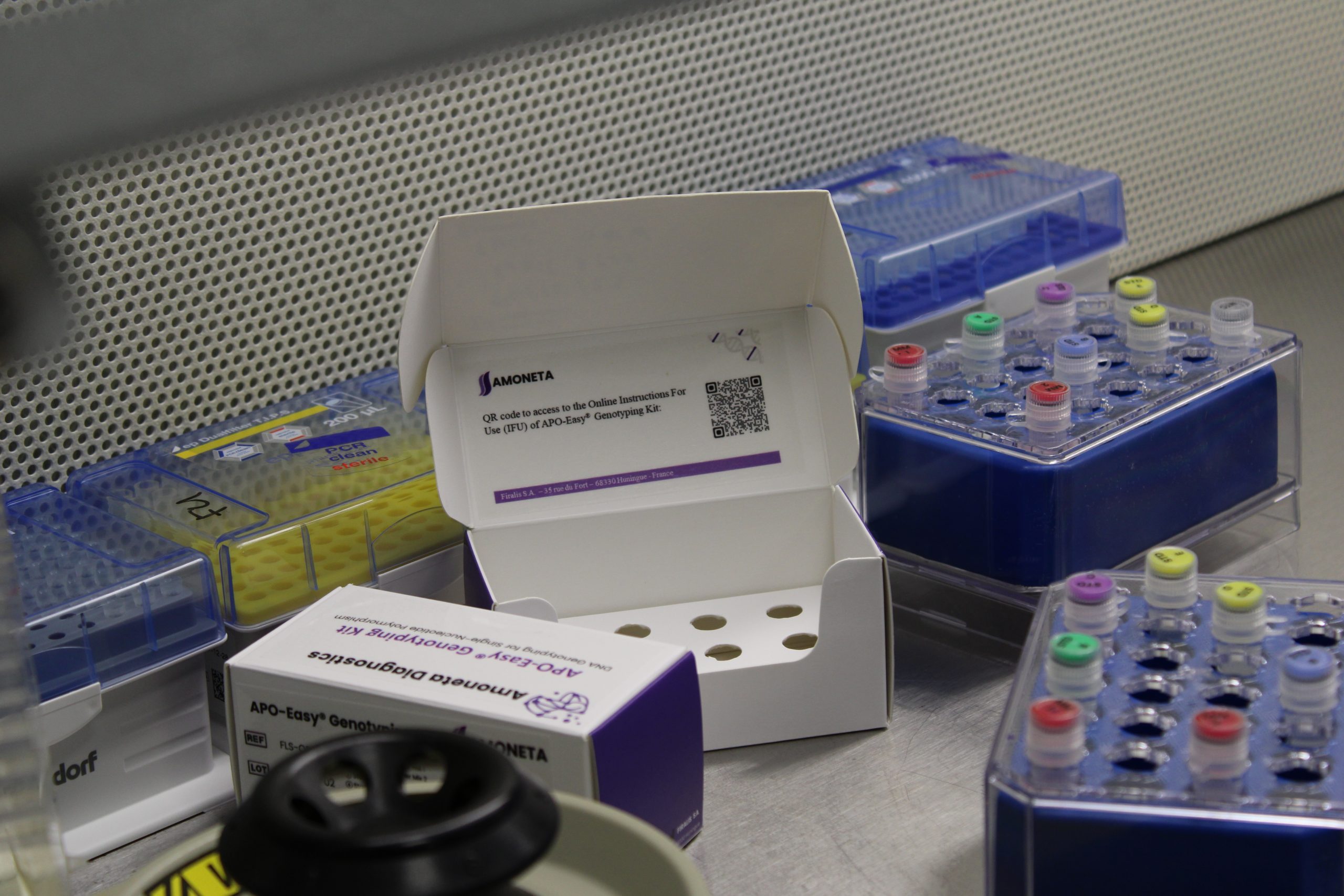
Amoneta Diagnostics’ APO-Easy® Genotyping Kit is the genotyping solution used in the study — to date, its largest single deployment.
A 50,000-participant decentralized cohort
ALZEVIT is sponsored by FIRALIS SA, based in Huningue (Haut-Rhin), which is contributing one third of the study’s €60 million budget. Recruitment runs for eighteen months and the pathway is fully decentralized: participants enroll online, receive a self-collection kit at home, and return it by mail at no cost. No site visit, no blood draw.
The study falls under category 2 of the French Jardé law, which covers research involving minimal risk and constraints. It received a favorable opinion from the Comité de protection des personnes (CPP) Île-de-France VIII on 8 June 2026, is registered under national number RCB 2026-A00246-45, and is declared to the CNIL under the MR-001 reference methodology.
APO-Easy® in the study
The APO-Easy® Genotyping Kit is CE-marked under the EU IVDR. It determines APOE genotype from 1 µL of saliva or blood using a PCR-based method that runs in about 90 minutes and requires no prior DNA extraction.
In ALZEVIT, collection is performed by the participant at home with a buccal swab (ORAcollect®•Dx), then returned to the laboratory in a prepaid envelope. That combination — self-collection at home and a fast, extraction-free assay — is what makes genotyping at this scale practical within an eighteen-month recruitment window.
Why APOE
The APOE gene exists in three main forms. ε2 is the least frequent and carries a protective effect, ε3 is the most common, and ε4 is associated with an increased risk of Alzheimer’s disease. Roughly 1 to 2% of the general population carries two copies of ε4, and 65% of patients with Alzheimer’s disease carry at least one ε4 allele.
Carrying ε4 is a risk factor, not a diagnosis: many carriers never develop the disease, and non-carriers do. Establishing how APOE variants are distributed across a national population, then following those trajectories over time, is precisely what ALZEVIT is designed to do.
Three phases over five years
- Phase A — genotyping of the 50,000 volunteers, producing the first picture of APOE variant distribution in France.
- Phase B — deep phenotyping of 2,350 participants, including 750 ε4/ε4 homozygotes: cognitive and neurological assessment, blood biomarkers, brain imaging, lifestyle data, multi-omics and micropollutant analyses.
- Phase C — longitudinal follow-up, building a trial-ready cohort for future prevention studies targeting the 14 modifiable risk factors identified by the 2024 Lancet Commission.
Study leadership
ALZEVIT is led by Prof. Audrey Gabelle, neurologist at CHU de Montpellier, as principal investigator, with Dr Stéphanie Bombois (Pitié-Salpêtrière) as co-investigator. Hüseyin Firat, CEO of FIRALIS, is directing the project alongside the hospital teams.
“I am delighted that this study is being carried out, because for years now we have needed to commit to prevention on a large scale.”
Prof. Audrey Gabelle, principal investigator
Support was expressed at the launch briefing by Maria Soto-Martin (French national strategy on neurodegenerative diseases), David Wallon (president of the Fédération des centres mémoire), François Sellal (vice-president of the Fédération française de neurologie) and Benoît Durand (managing director of France Alzheimer).
In the press
- Vidal — 11 September 2026. A detailed presentation of the protocol, the three phases and the participation criteria, based on the APMnews dispatch.
- France 3 Grand Est — 17 September 2026. A general-audience report on the call for 50,000 volunteers, launched from the Haut-Rhin.
- L’Alsace — 10 September 2026. The announcement seen from Alsace, where FIRALIS is based. (subscribers only)
- Traces Écrites News — 10 September 2026. A business perspective on the project and its partnerships. (subscribers only)
Learn more
Full details of the study, the eligibility criteria and the participant pathway are available on the ALZEVIT study website. Information on the kit itself is on our APO-Easy® product page.